Hyperintention and Hyper-reflection: The Paradox of Pleasure
May 7, 2026
How hyperintention and hyper-reflection (hyperattention) according to Viktor Frankl sabotage our lives.
This article is, for the most part, a philosophical outburst. Sort of like Catcher in the Rye, I’d say. Don’t expect much from it. I usually don’t have the resources for a more rigorous approach, with field research and statistical analysis of a huge sample space, so I’m left trusting my practical experience which may not even be palatable to some.
Lately I’ve been constantly bombarded by content on social media that transforms serious themes into shallow entertainment spectacles (which is nothing new). One of them, in particular, has caught my attention: the discussion about mate choice in the human species. What should be a deep subject, connected to psychology, biology, and existentialism, has become just another endless hype, reduced to cheap self-help advice, jokes, and tribal disputes.
For many, the “meaning of life” — a central concept in Viktor Frankl’s Logotherapy — seems to have been degraded to a mere search for immediate relief, validation, and others’ approval. Instead of a deep and guiding motivation, it has become just another item on the list of egoic desires being shared on social media profiles to stir up nerves.
I confess I’ve always had difficulty using social media frequently. Part of this comes from my own solitude and anti-social inclination: having few friends protects me from engaging in unnecessary conversations and from seeking attention that, most of the time, adds nothing.
On the other hand, what bothers me most is the hype mechanism: the pressure to only produce or consume what’s “trending” without considering the quality of what was produced or the producer. When we don’t align our genuine interest with what the algorithm values at the moment, everything seems to fall into the void. I say “seems” because on the internet everything is recyclable. What generates likes and engagement today is already forgotten tomorrow, being replaced by a new cycle of equally disposable content, or it’s retrieved as the years pass.
Deep down, what we see in these shallow discussions is a perfect example of two mechanisms that Viktor Frankl identified decades ago: hyperintention and hyper-reflection (or hyperattention).
These people (whom we generally don’t know) aren’t really seeking meaning or a compatible partner. They’re hyperintending — desperately forcing a result (validation, status, sexual desire, approval) that can only arise spontaneously and naturally. Away from social media. The more they try to manufacture attraction, “high value,” or meaning through poses, performative arguments, and calculated content, the more they push away exactly what they desire in the physical world.
At the same time, they live in constant hyper-reflection: obsessed with their own image, with how they’re being perceived, with the number of likes, with their own “life narrative.” Instead of living, they’ve become critical and anxious spectators of themselves. And predictably they acquire: anxiety, chronic frustration, and an even greater void. Content that isn’t posted because many are busy in therapy or doing anything else that there’s no time or essential reason to publish about.
I believe anyone has had romantic disappointments, contact with unwanted situations, or personal problems they didn’t know how to solve. A problem I had with the growth of social media in the 2000s, for example, was: how to mitigate irrelevant content. And the solution I found was: read articles in an RSS reader or, enter Youtube only through the URL https://www.youtube.com/feed/subscriptions. That way I wasn’t recommended bad videos daily every time I opened the main page.
The phrase “you are what you consume” was always the reason to learn to have control over everything I consume — videos, articles, documentaries, food, medication, online content — filtering everything in one place was the most effective way I found not to get lost in constant redundancy or in things I don’t deeply understand and have no interest in discussing.
Generally I call many of these online discussions collective unemployed disorder, where having opinions about everything in a few minutes of consumption has become the internet’s main hobby. And it should be seen as such.
Frankl already warned: the more we focus directly on ourselves and on our immediate desires, the less we can accomplish what really matters.
Today I see this frequently in modern dynamics. In the universe of dating apps, for example, there are those who enter with the rigid determination to “get a serious relationship this month” or find someone who meets an endless list of criteria. The person forces conversations, analyzes every message, tries to seem more interesting or “high value” all the time. The result is almost always the opposite: interactions become artificial, natural attraction doesn’t flow, and the pressure scares away exactly what is desired. The number of testimonies from people who joined and gave up on these dating apps is countless. https://reddit.com is full of them.
On social media, the content creator obsessed with going viral with the next post does the same. They research trends, calculate perfect times, use all engagement techniques, and update metrics obsessively. Over time, authenticity disappears, the content feels forced, and the algorithm, ironic as always, tends to reward less those who are clearly “trying too hard.”
Working hard won’t always reward you proportionally. I say this because I’m just another idiot you can call an “influencer” or “blogger” who spends hours reading and writing about what interests me here. As a side effect I help some in my spare time with no compensation for it. I can’t quantify and objectively write how many people have already failed due to high expectations of themselves. That’s a human limit, after all, even I’m not exempt from these disappointments. That’s why many of the questions I’m asked are bad, and most of these constant doubts about self-performance have no answer outside the attitudinal field. They’re wrong in any answer that’s given because all depend on action. Questions like:
- Is this the right thing to do?
- Should I really stay with this person?
- Will they like my new post?
- Should I stop doing what I’m doing because it doesn’t bring results?
These are common examples we ask ourselves day after day. And none have a right answer. Every subject is destined to externalize these concerns in countless ways. With the internet this has become increasingly easier and worse, it saves you from the lack of maturity of trying to put things into practice and allowing yourself to fail. They’re usually questions loaded with personal concerns that demonstrate a small problem of momentary demotivation. That, when asked to the wrong person, can have serious consequences by people with terrible influence.
Another classic example is sleep. The person who “needs to sleep well because tomorrow there’s an important meeting” lies in bed and begins to try to relax with all their strength: counting sheep, putting the phone aside, using breathing techniques, checking the clock every few minutes. And the more they force sleep, the more it runs away.
It’s even funny because I’m tired of hearing about this “sleep hygiene” as a method to sleep well. Being from the Computing field I always chose to be self-taught and study at night. But I never understood why I got so annoyed when they recommended it to me. Later I realized that actually my problem is the name given to the method.
Stop to think… if sleep is something good and improves our well-being, why would it need hygiene in the first place?
If sleep hygiene consists of: improving diet, defining your bedtime, establishing wake-up time, turning off lights and keeping a quiet environment. Then this isn’t “sleep hygiene” itself. This is hygienizing or disciplining the subject with poor behavior. Making noise in the middle of the night, getting stimulated by screens every single day, swapping day for night without any purpose or goal, is at the very least a diagnosis of lack of commitment or discomposure. Confucius would say that wisdom is achieved when we call things by their true names. So how about we stop treating a lazy or irresponsible person as a “sleep polluter”?
None of these things was my case. Pulling all-nighters was never something recommended by anyone. I never recommended it. It was just a necessity of mine and probably of many others who needed more work time.
We see these phenomena increasingly present in the frantic search for happiness: those who transform well-being into a direct objective, buying courses, doing forced meditation, traveling to “find themselves” and consuming self-help content nonstop. The pressure the individual puts on themselves to “be happy now” tends to generate exactly the opposite — frustration and the constant sensation of inadequacy.
In productivity and creativity it’s even more common. Professionals who sit down to work thinking “now I’m going to be extremely productive and creative” end up blocking their own flow without even realizing it. The internal pressure transforms a natural activity into a tense and rigid task. And much of the results come unexpectedly due to unhealthy self-demand.
Finally, in social life: those who go to an event determined to “be super sociable, funny, and charismatic” mentally rehearse behaviors, monitor every other person’s reaction, and excessively control their own image. The exaggerated effort leaves them rigid, less authentic, and consequently less connected.
We live in a culture that values total control and immediate results. Apps, metrics, toxic productivity, and constant dopamine train us to hyperintend almost everything — relationships, success, happiness, sleep, mental health — what once would happen naturally, today is pure entertainment disguised as cynicism in trending topics. And in the real world this is increasingly evident. The more society tells us “you can and should control this,” the more we fall into this error described by Frankl.
Logotherapy: Stop Trying to Be God
Viktor Frankl didn’t limit himself to diagnosing the problem. He developed practical and extremely effective techniques to break these vicious cycles. The two main ones are dereflection and paradoxical intention.
Dereflection consists of withdrawing the excessive focus from oneself and redirecting it to something greater. Instead of becoming obsessed with “how I’m feeling,” “how I’m being seen,” or “am I getting the result I want?”, the person turns their attention to values, tasks, other people, or a purpose that transcends the ego.
Frankl repeated: “Forget yourself and realize yourself.” The more we forget ourselves in favor of something meaningful — a job well done, helping someone, creating something useful, truly loving —, the more naturally the symptoms of hyperintention and hyper-reflection diminish. The human being doesn’t heal by gazing at their own navel, but by addressing the world.
The second powerful technique is paradoxical intention. It works especially well when there’s anticipatory anxiety (the fear that something bad will happen) or FOMO (fear of missing out). In it, the patient is encouraged to desire, in a humorous and exaggerated way, exactly what they fear the most (reverse psychology).
For example, instead of sleeping while demanding a good sleep, you can externalize:
Those afraid of not sleeping are invited to try to stay awake as much as possible (“today I’m going to break the insomnia record”).
Instead of fearing embarrassment in lectures or public debates you can externalize with jokes:
Those afraid of stuttering or being socially embarrassed are encouraged to try to stutter or make a fool of themselves on purpose.
In dating, instead of forcing “being attractive” or “not messing everything up,” you can adopt an internal posture of “I’m going to be as boring as possible today” — which, paradoxically, reduces pressure and frees spontaneity.
Humor is an essential element in this technique. Frankl saw humor as a form of transcendence: when we can laugh at our own neurosis, we’re already above it.
Many who suffer from hyperintention and hyper-reflection seem, deep down, to want to be God. They demand from themselves to be good at everything, pleasant for everyone, emotionally available all the time, performative in all areas, and on top of that “authentic.” This divine self-demand inevitably generates frustration, exhaustion, and an even greater existential void — because no human being can bear the weight of being omnipresent, omniscient, and perfect.
While Frankl invites us to come down from the throne of self-exigency and assume our limited humanity, the cynicism of social media does the opposite: it reinforces the illusion that it’s possible to control everything, be admired by everyone, and never fail. And this only generates: more pressure, more rigidity, and less life.
The Foundation of Everything: The Will to Meaning
Both dereflection and paradoxical intention only work because they start from the central principle of Logotherapy: the human being is moved, above all, by the will to meaning. When this search is blocked or distorted (by social media hype, by cultural pressure of performance, by the incessant search for immediate relief and momentary pleasures with apps and fake wives, or by the desperate search for validation), hyperintention and hyper-reflection arise.
The definitive solution isn’t to “relax” or “not care,” but to replace the egocentric question “what do I want from life?” with the Franklian question: “What does life expect of me in this moment?”
It’s like in the film Mishima:
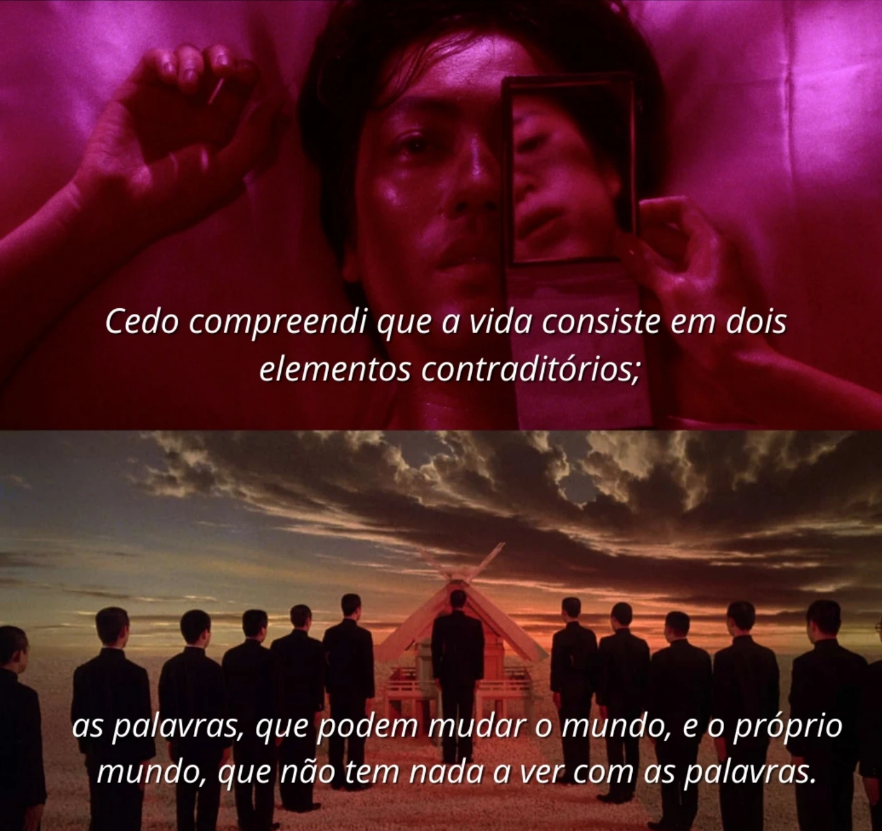
When we shift the focus from demand to responsibility, much of the internal pressure dissolves. The world doesn’t expect something from you. You’re already bad enough to pay attention to yourself. Imagine if the world were attentive to your constant failures telling you how you should react? Seeking results when just the act of doing is already a goal, will bring you frustrations and possibly your desires will be seen being built by others. In the end it can even hurt your heart with envy.
Why not be an idiot with yourself? Allow yourself to fail. All the craving for immediate relief and momentary pleasures will be bypassed by a trajectory that only you can call yours. Follow your own path. Be yourself. The world waits for you, it doesn’t demand from you.
Live long and prosper… Little dickhead. 🖖