Effort, Time, and Money
April 9, 2026
At the core of the libertarian view of economics, especially as developed by the Austrian School, lies the understanding that all true wealth arises from intentional human action — from individual effort directed through time, coordinated through voluntary exchange. Authors like Ludwig von Mises, Murray Rothbard, and Israel Kirzner emphasize that the market is not an impersonal “distribution” mechanism, but a dynamic process of discovery, creation, and coordination of scarce resources through entrepreneurial action.
This perspective rejects the statist and Keynesian illusion that money, inflation, or easy credit can create prosperity out of nothing. On the contrary: money is merely a medium of exchange, a derived instrument that facilitates social cooperation. It does not generate value on its own — it reflects value previously created by human effort.
Look at the meme and analyze it for yourselves:
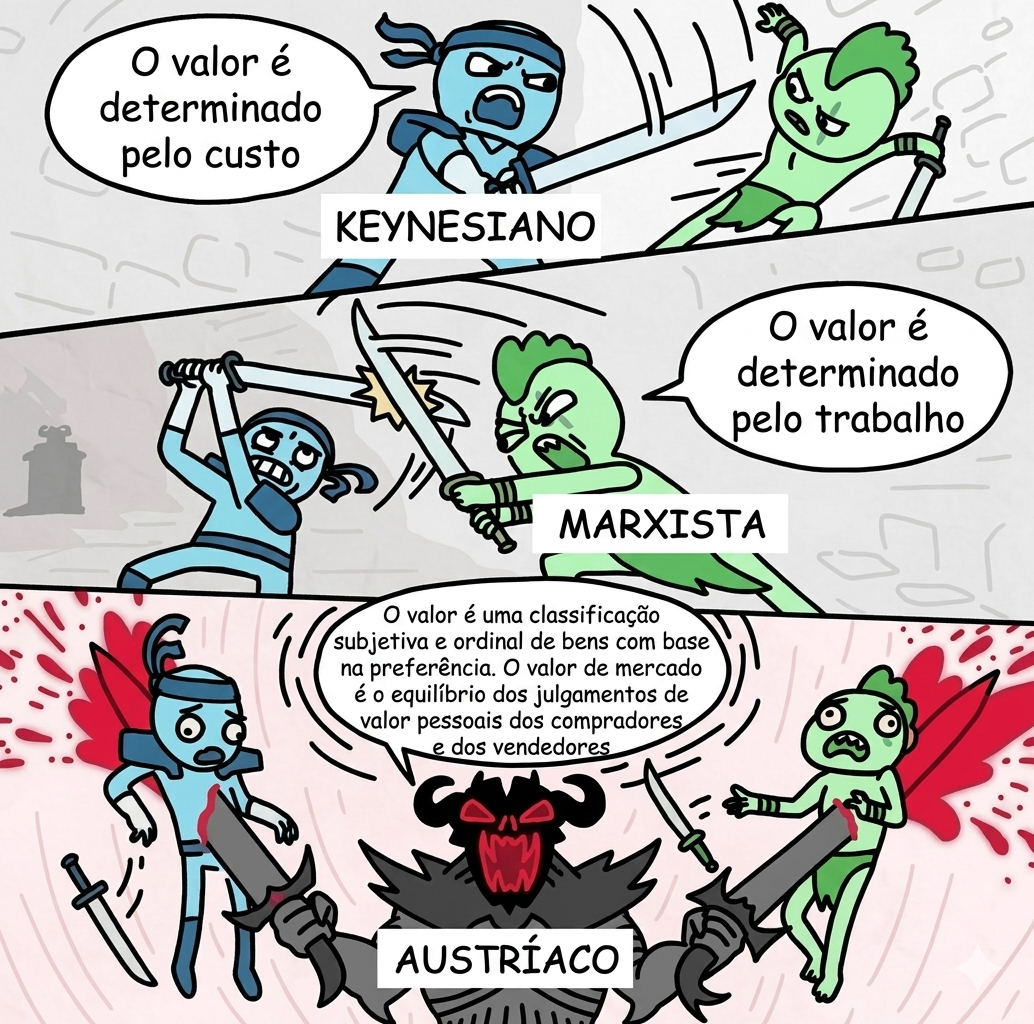
In the libertarian tradition, the question of economic value is not a technical detail — it is the heart of the dispute between antagonistic worldviews.
While Keynesians and Marxists still argue over whether the value of things is determined by the cost of production or by the amount of labor embodied, the Austrian economist enters the battle with a radically different truth: value is subjective. It resides neither in cost nor in the labor expended by the producer. Value arises from the mind of the individual who evaluates, prefers, and chooses. It is a subjective and ordinal ranking of goods based on personal preferences. The market price, in turn, is nothing more than the result of the equilibrium between the value judgments of buyers and sellers in a voluntary process of exchange.
This meme masterfully captures that ideological battle. At the top, the Keynesian shouts that “value is determined by cost.” Below, the Marxist counterattacks asserting that “value is determined by labor.” Both are quickly put in their place when the Austrian — transformed into a powerful and bloodthirsty demon — reveals the true nature of value: a subjective reality, born from individual human preferences and spontaneously coordinated by the market.
This image is not just funny. It perfectly illustrates why the Austrian School represents a watershed in economic thought: it rejects objectivist theories of value (whether of cost or labor) and returns to the sovereign individual the central role in determining what is valuable.
It is within this same subjectivist and praxeological logic that it makes sense to analyze the fundamental hierarchy between effort, time, and money. Just as value cannot be imposed by objective formulas of cost or labor, true wealth creation also cannot ignore the natural order of precedence of the three elements I want to bring up in this post.
Ignoring this order leads to common confusions, such as believing that money can replace time or that time, by itself, produces results. However, when analyzed more carefully, it becomes clear that each of these factors depends on the previous one to exist meaningfully. I often treat these three factors as interchangeable, yet there is a silent hierarchy among them. Ignoring this order generates the same illusions that afflict Keynesians and Marxists: believing that it is possible to create value or wealth without respecting the reality of human action.
Understanding this dynamic is not just a theoretical question, but a way to see more clearly how we build, maintain, and lose what we consider important.
The order of precedence is effectively valid only if organized as follows:
I. Effort > Time.
II. Time > Money.
III. Money > Effort (in a derived sense)
Effort precedes time because it is in moments of difficulty that raw effort becomes necessary to create, maintain, or recover what matters. Without initial effort, time becomes empty.
Time precedes money because, to generate money, one must invest time in producing goods or services that others voluntarily value.
Money, in turn, only exists as a derived instrument. It cannot precede effort, for money has no creator of its own: it arises precisely to compensate and facilitate the effort of others. Money only has value because someone, at some point, exerted effort to produce it or to create it as a medium of exchange. Without the originating effort (of the creator, the producer, the worker), money would be mere fiction without backing. Therefore, effort always logically precedes money.
If we let money precede time, we fall into the illusion that the existence of time is simply purchasable, ignoring that time without directed effort generates nothing lasting.
If time preceded effort, the very concepts of effort and time would lose meaning: why make an effort if time is not a symbol of a destination? If immortality were the universal reality of every individual: having more time would simply mean “not exerting effort.”
If effort absolutely precedes money (as it should), we understand that chasing money without one’s own effort or without coordinating the effort of others is futile. Effort is the source; money is merely the tool that emerges afterward.
Live long and prosper… hard-working. 🖖